suecrook513802eyv

Level 1 course for BA Photography Degree
express your vision
open college of the arts
A1 - Square Mile
“Photographers and artists have always found inspiration in their immediate location. There is a concept within Welsh culture called Y Filltir Sgwar (The Square Mile). It is the intimate connection between people and their childhood ‘home’ surroundings”.
Brief:
I have been asked to take a series of six to 12 photographs in response to the concept of ‘The Square Mile’. The images should be a series and ‘sit’ together to complement one other. I can photograph architecture/landscape/people or deviate from this. Each photograph can be titled or have captions.
There is no ‘right’ or ‘wrong’ way to respond to this brief but the images I take should communicate something about me: my interests, motivations and ambitions for my photography and should push me out of my comfort zone. I should also take this as an opportunity to introduce myself to my tutor through my work.
Assignment 1 – SQUARE MILE – Y FILLTIR SGWAR
When I first read this assignment I was filled with dread as I live in a little village with no architecture/shops/clubs or anywhere interesting to photograph. I am surrounded by hills and fields. I could have done landscapes for the assignment but as I began to think in depth of where I used to play and various other things I realised it wasn’t as boring as I thought in the first place.
First thing I did was download a map off the internet and mark little squares on it to see where anything happened; there were a lot of ‘firsts’:
-
my first flat
-
first job
-
bought my first car
-
first broken bone
-
Second thing I did was a mind map to plan out my assignment, such as research/what was required
-
Third thing I did was go for a walk around my immediate area and look at places where I used to play when I was a child. Most of it had gone either by housing developments or just over grown with trees. I then began to think what was important to me now – family/job/hobbies/study and an idea began to form.
-
-
I had recently bought a Canon 5diii, I had always had 2nd hand or hand me down camera equipment before and had spent a year or two saving for some money to buy a brand new state of the art camera. I wanted to show in this assignment how different the finished image was in detail and to show off what my camera could do and what I had recently learnt.
-
I have always been interested in other art movements such as cubism/impressionism and began to wonder if I could do something similar with long exposures? Looking on ‘youtube’ I then saw information on ‘multiple exposures’ for my camera and watched many of the videos on it and became fascinated by it. -
I began to have a look at other students blogs as I had never blogged before and saw that some deviated from their square mile and used where they worked which would have been a better idea for me as there are more places around Newport to photograph, but as I am a fulltime carer for my mum and only work one day a week, would only have a 30 minute lunch time to take the photos or leave her and that was not acceptable so I decided to stay true to my homes square mile and continue with photographing my immediate area. -
The idea developed from the multiple exposure idea of photographing Wattsville by using different techniques and investigated what my camera could do and this is what I came up with:
-
multiple exposures
-
night-time photography
-
filters/colour conversion
-
panning
-
fish eye lens
-
something in front of the lens eg lace/tissue
-
infra-red
-
sepia
-
movement
-
flipping an image
-
panorama
-
paint/sketch effect
-
HDR mode
-
Shoot through car window through rain.
IDEAS for Assignment
-
1 – at the moment Im interested in multiple exposures and making my camera do unusual techniques and could use this as an idea of making my surroundings a bit more interesting. I will research this further
- 2 – my mum uses a wheelchair and we find it quite difficult to get round the village, some parts are no go areas. I could take photos of the empty wheelchair (on its side/stuck in mud etc) in various locations where we can’t get too, to show these problems? Please see diary entry 26/01/15.
Final Idea:28/01/15 – I have decided to go with the first idea, the more I think about it the more appealing the idea is and it will show my tutor where I am with my photography as I am trying to push boundries with my camera. I will use different techniques to shoot Wattsville in a way I haven’t photographed it before, eg Multiple exposures/night photography/filters and processing. This way it will make me think and use newer techniques which I haven’t attempted and force me to think out of my comfort zone. I would like to continue with this idea after the assignment and produce a book to give to relatives as presents who have moved away. The book will be set out with the left page a standard landscape of the village and the image on the right a new technique I have explored such as day time then using night time shots as the 2 images. A before and after book. For the assignment I will combine the 2 images as a collage
I have looked at my books and found ‘The Encyclopedia of Photographic Techniques’ by Adrian Davies and will jot down the ones suitable for this type of photography.
Contact Sheet
My Final Images
My earliest memory is my mum holding me and showing me things out of my bedroom window like birds or my dad in the garden below. I’ve cropped the 1st image as a corner of the window showed in it and increased the colour saturation by 10% as it was a dull day and snowing.
My house – Ive lived here a long time. I took 3 images of this and merged them together in camera to get a better image/more interesting. Cars passing at speed also give this image movement.
The street where I live. This is a day and night shot. The night shot has light trails in it of a bus going past.
A shot through security glass distorting the original, making a simple shot abstract and hopefully more interesting than the original picture.
My allotment. I managed to take some pics of me in the garden using the multiple exposure setting on my camera. These are my favourite shots of the set. I would like to do this again when the summer is here as I am shooting towards the sun, which is quite low in the sky so there is some flare, but I have used a vignette filter on the collaged image which hides it slightly.
This is the Chapel where I spent a lot of time as a child. I have just tidied up the image and cut the lamp posts out of it. I have tried to use the ‘rule of thirds’ making the Chapel the main part of the image.
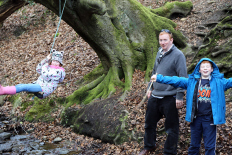
My cousin and his children came up from Norwich to visit us. He hadn’t been ‘home’ for a while and wanted to show them where he used to live and play etc. We had a good time wandering round and looking at the old haunts. The kids found a rope swing and it brought back memories as we used to do the same thing as well. You can see how much the kids were enjoying being outside even though it was cold and damp but everyone was smiling even me when I took the photo!
Reflection:
I would like to revisit this assignment and update it as I become more confident with my camera. The camera is new so I am still trying to find out what it can do. Maybe in hindsight I should have just taken straight forward images for this first assignment but I wanted to know what I could do with the camera. I have enjoyed doing the before and after images and submitting them as a collage, its a new skill I have learnt since doing this assignment. This shows my tutor the differences between each image immediately, without having to turn a page or look at another image – its just a ‘before and after’ shot. I have enjoyed this process and will use it again. I wasn’t sure if to count each collage as one or two shots – some have used two shots in camera and some have been altered via software, some of the multiple exposure images have 3 different shots in one photo, so I have decided to just submit nine.
Demonstration of Technical + Visual Skills: using cropping, multiple exposure and new techniques, using typical photography rules such as rule of thirds. Cropping out items such as lamp-posts to make a better image. Getting prints done at a professional print shop. Using the before and after images as design skills. Multiple exposure explores new skills using my new camera.
Quality of Outcome: trying to keep the ideas simple and flowing so that the reader can understand what the imagery meant. Using the before and after image to communicate the idea of the image.
Context: Using Youtube and the Net for research. reflecting on the ideas and what they meant to the assignment brief and being critical of my work.
Demonstration of Creativity: By using new techniques such as multiple exposure and blogging
Tutor Report
Feedback on assignment
Firstly, in response to your queries as to whether or not photographs that have been altered in one way or another are appropriate for the square mile project - I have no problem with you using this approach. The reason that the course documentation suggests not doing so is simply to avoid students spending inordinate times on this, and to encourage them instead to complete this assignment fairly quickly, assess where they are and move swiftly forward. [At the end of each assignment, a conversation with your tutor (by Skype Tutorial or by telephone) can assist enormously in the development of your work, and you should plan for these short contacts (30-45 minutes) at the end of each assignment.]
I like the way in which you have displayed your ideas for this assignment as pairs of images. Looking at two images placed side by side, we immediately read one image off the other. In other words, you begin to create a narrative tension between two images. This strategy can be very useful when, for example, you are trying to tell a story and works well in relation to your chosen subject – the square mile– as you begin to explore the ‘before and after’ narrative so appropriate when documenting an area which you know well.
What is interesting in regards to this project and your specific circumstances is that you have lived in the same place for a considerable period of time. This clearly means that each site you visit on such a project must hold not only one but perhaps many memories. Using the multiple exposure techniques in this case makes sense, as these memories must act in a similar way to the multiple exposure images? The use of the multiple image (i.e. the use of the diptych, triptych, grids of images etc.) but also the multiple image within the single frame (i.e. multiple exposure techniques) are often used to suggest the passage of time, and in fact the history of the depiction of the passing of time in photography is a fascinating one, which changes from decade to decade as new tools become available to the photographer.
Reading your descriptions of your own experiences (for example the stories relating to a rope swing near your home) was evocative. The picture that you submitted in support of this was a snapshot of your relative revisiting the same site. Imagine, however, you were to present this (or a similar image) alongside an image of you taken as a child on the same spot. How then would you read the two images? Many photographers use historical or archival photographic material as well as the strategy of re-enactment to suggest the intervening passage of time. I like your own description:
‘I started off with constructing a mind map of my area and my life. This was relatively easy as I began to realize that all my 'firsts' had happened within the Square Mile – first school, first job, first home, bought my first car in the village, first broken bone falling off a tree swing – the list is endless...’
There are some great ideas there perhaps for future projects and/or further development of the work begun as part of the square mile project?
Learning Logs or Blogs/Critical essays.
Recently, there have been some very interesting artist projects surfacing that use (often digital) layering to explore the passing of time. It might be interesting for you to think about how (if) many of these sites have changed in the years you have been in the village? Can these changes be documented in still photography?
Look at other photographers who have documented the English Village, notably British photographer Ann Fox, who takes a creative approach to documentary practice. In her project ‘The Village’ (1991-93) she builds up a picture of a village community. You can see some of this project here: http://www.annafox.co.uk/work/the-village/
This work of course is highly figurative. Others choose unpopulated shots to describe their ‘square mile’. Both strategies work well but in quite different ways. Your allotment, with the themes of growth, and change is an obvious one to continue to develop in this context. Many photographers have found this to be a great subject. The allotments of course can be pictured at all times of the day. Perhaps shooting at dawn and dusk and comparing the two images?
At this stage in your studies, it is recommended that you familiarize yourself with a variety of approaches and research widely. Through this research you will begin to work out which approach is of the most interest to you. It is important to get to exhibitions, engage in study visits and general make yourself aware of the breadth of practice available. Your learning log should contain reviews (500 words recommended minimum) on any of these events relating to your studies.
As well as images, your LL can contain scanned pages from sketch books, etc. (for example, it can include the mind maps of your area and your life that you worked on in preparation for the square mile assignment.
Suggested reading/viewing
Peter Fraser: a good example of how a photographer can elevate the close to hand and often mundane into something significant and precious: http://www.peterfraser.net/video/peter-fraser-in-conversation-with-paul-wombell-at-brancolini-grimaldi-during-the-exhibition-a-city-in-the-mind/
Charlotte Cotton’s book ‘The Photograph as Contemporary Art’;
This is a useful primer to introduce you to current developments in contemporary photographic practice: http://www.thamesandhudson.com/The_Photograph_as_Contemporary_Art/9780500204184
Pointers for the next assignment
For assignment 2, please arrange in advance by email a time to discuss your submission to allow me to integrate this feedback into your final report.


Resubmitted elements to add to A1

I decided to revisit The Square Mile as my Photoshop skills got better.
I spent a lot of time playing as a child in this back lane and again a lot of my 'firsts' were accomplished here. First time i rode my bike, first broken bone, first time i drove my dads car.
This shot is looking down and up the lane. You can see where the upper lane has been surfaced by the council and the lower lane hasnt because they ran out of money, half way down.
It was suggested I look at the work of Peter Fraser as he has a fresh way of turning everyday mundane objects into something artistic and precious. This was a good idea and made me look at things differently as it is very hard to find something new in an area you see everyday.
Fraser uses colour/shapes and abstracts to look at things differently. His exhibitions in 1986 photographing the mundane used everyday objects such as brightly coloured buckets and paper planes.
Anna Fox - the village http://www.annafox.co.uk/work/the-village
Fox took photos of her surrounding area and looked at things differently such as parts of houses through trees or fences and close up/abstracts of people in her community.
What have I learnt from this assignment?
How to look at things differently? Even though you see something every day you can still photograph it with a different technique or twist.